
Epoxy vs Polyaspartic Garage Floor: Which Fits
Stoutwell Garage Renovations · September 30, 2026 · 4 min read
Epoxy and polyaspartic are less rivals than two materials with different strengths. A coatings supplier says polyaspartics do not yellow or chalk in sunlight and cure faster than epoxies, which favors them as a topcoat where sun reaches the floor. Epoxy is still a common base layer, and on any slab, prep and moisture decide the result more than the resin does.
The short comparison
| Question | Epoxy | Polyaspartic |
|---|---|---|
| Sunlight | Can yellow or chalk | Does not yellow or chalk, per the supplier |
| Cure speed | Slower | Significantly faster, per the supplier |
| Cold-weather install | Often temperature-restricted | Can be applied in colder environments, per the supplier |
| Prep and moisture | The same slab work applies | The same slab work applies |
The first three rows come from a coatings supplier’s description of the two chemistries, not from a test of your floor. The last row is about the concrete, not the resin.
Sunlight and yellowing
Pflaumer, a coatings supplier, says that unlike epoxies, polyaspartics do not yellow or chalk when exposed to sunlight. That matters if the garage door is often open, if windows face the floor, or if the coating runs out to an apron or side entry. If the floor is mostly shaded, the advantage carries less weight and other factors can decide it. Yellowing is one of several epoxy garage floor downsides, each with its own fix.
Cure speed and cold weather
The same supplier says polyaspartics cure significantly faster than epoxies and can be applied in colder environments, as low as -20 F, while epoxies are often temperature-restricted. Read that as a description of a product class, not a promise for any job. Actual cure time and application range come from the data sheet of the exact product, so ask for them in writing rather than accepting a general assurance.
Faster curing does not remove other steps. Grinding, moisture testing and any flake layers still take time.
Prep decides how either coating bonds
According to PPG’s garage floor prep guide, a mechanical grinder roughs the surface and makes it porous enough for the coating to bond. A moisture test is part of the quote. The result is known only after the slab is tested on site, and a wet reading can change the prep, the system and the price. A polyaspartic over a damp, poorly ground slab has the same bonding problem an epoxy would. Prep is also the main gap between a store kit and an installed floor (DIY epoxy kit vs professional garage floor coating), and the main reason one coating lasts longer than another (how long garage floor coating lasts).
Hybrid and flake systems
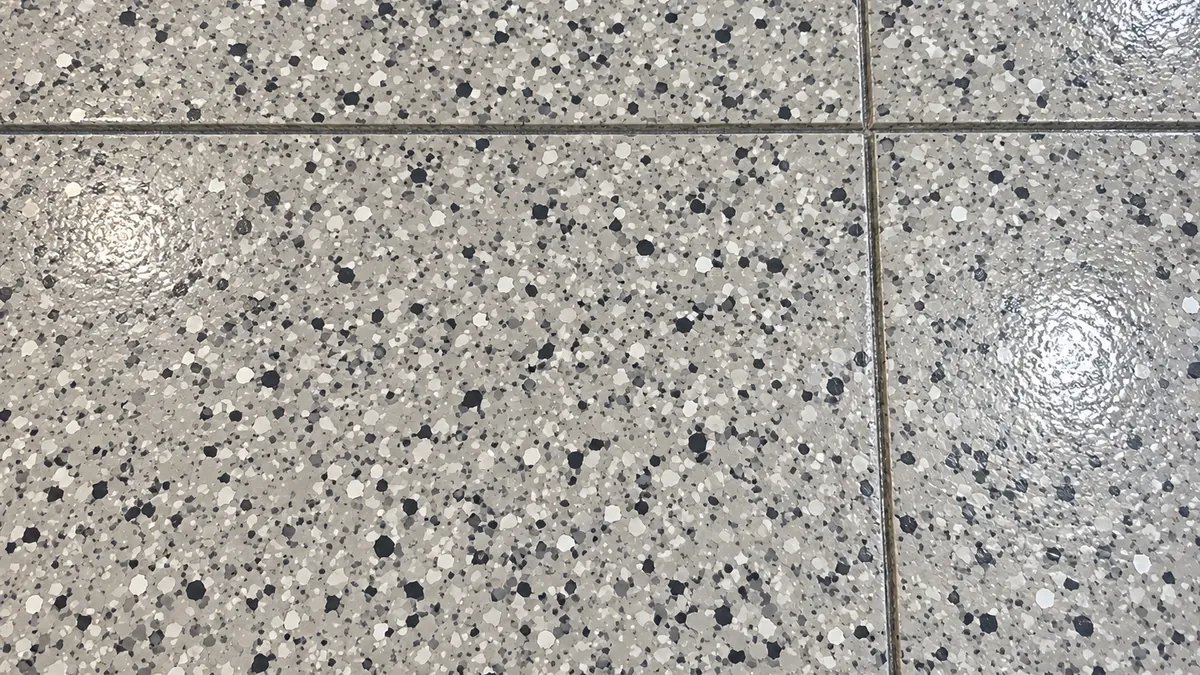
A flake floor can be built in layers, and PPG notes that a multi-layered decorative flake finish is more involved than a simple coat. The real question is often which resin goes in which layer. A common build is an epoxy base, a flake broadcast for color and texture, and a polyaspartic topcoat. When you compare bids, ask each installer to name the base, the flake and the topcoat separately, because two quotes that both say “polyaspartic” can describe different systems. How those choices move a quote is in the epoxy garage floor cost guide, totals by garage size are in the cost to coat a 2-car garage floor, and whether the spend pays off is in is garage floor coating worth it.
Questions to ask an installer
- How will the slab be ground, and to what finish?
- Is a moisture test done, by which method, and what happens if it reads wet?
- Which resin is the base, and which is the topcoat?
- What temperature range is the product rated for, and what happens if the weather changes mid-job?
Local notes
Where a local climate fact is sourced, we put it next to this comparison:
- Houston, TX: yearly rain and summer heat
- Raleigh, NC: winter road brine
- Madison, WI: cold winters
FAQ
Is polyaspartic better than epoxy for a garage floor?
For the top layer, often yes where sun reaches the floor. A coatings supplier says polyaspartics do not yellow or chalk in sunlight, unlike epoxies. Epoxy is still commonly used as a base coat, so many systems use both.
Can polyaspartic be applied in cold weather?
A coatings supplier says polyaspartics can be applied in colder environments, as low as -20 F, while epoxies are often temperature-restricted. Ask for the written application range of the exact product proposed.
Does the resin matter more than prep?
Not usually. Grinding and a moisture check decide whether any coating bonds. A resin choice does not fix a poorly prepared or damp slab.
Next step
Use the questions above as a checklist for any quote you receive, then compare the written scopes line by line. If your garage is in one of the areas we serve, our free written quote names the base, the flake and the topcoat, so you can see exactly what goes on your floor.
Want Advice on Your Own Floor?
A guide can explain the options. A free quote tells you what your slab needs.
 Comparison
Flake vs Metallic vs Solid Color Garage Floors
Flake vs metallic epoxy vs solid color garage floors: how each looks, grips, hides dust and slab flaws, cleans and handles sun, and which garage each suits.
 Comparison
Garage Floor Paint vs Epoxy Coating
Garage floor paint vs epoxy: how paint and one-part epoxy paint compare with a professional epoxy system on bond, film build, hot tires, chemicals and life.
 Comparison
Garage Floor Tiles vs Epoxy Coating
Garage floor tiles vs epoxy: how interlocking tiles and a bonded coating compare on install, cracked slabs, water under the floor, cleaning, look and removal.
Ready for a Free Quote?
Get a free, no-obligation quote for your property.
Get Your Free QuoteOr call us directly: (919) 219-2946